

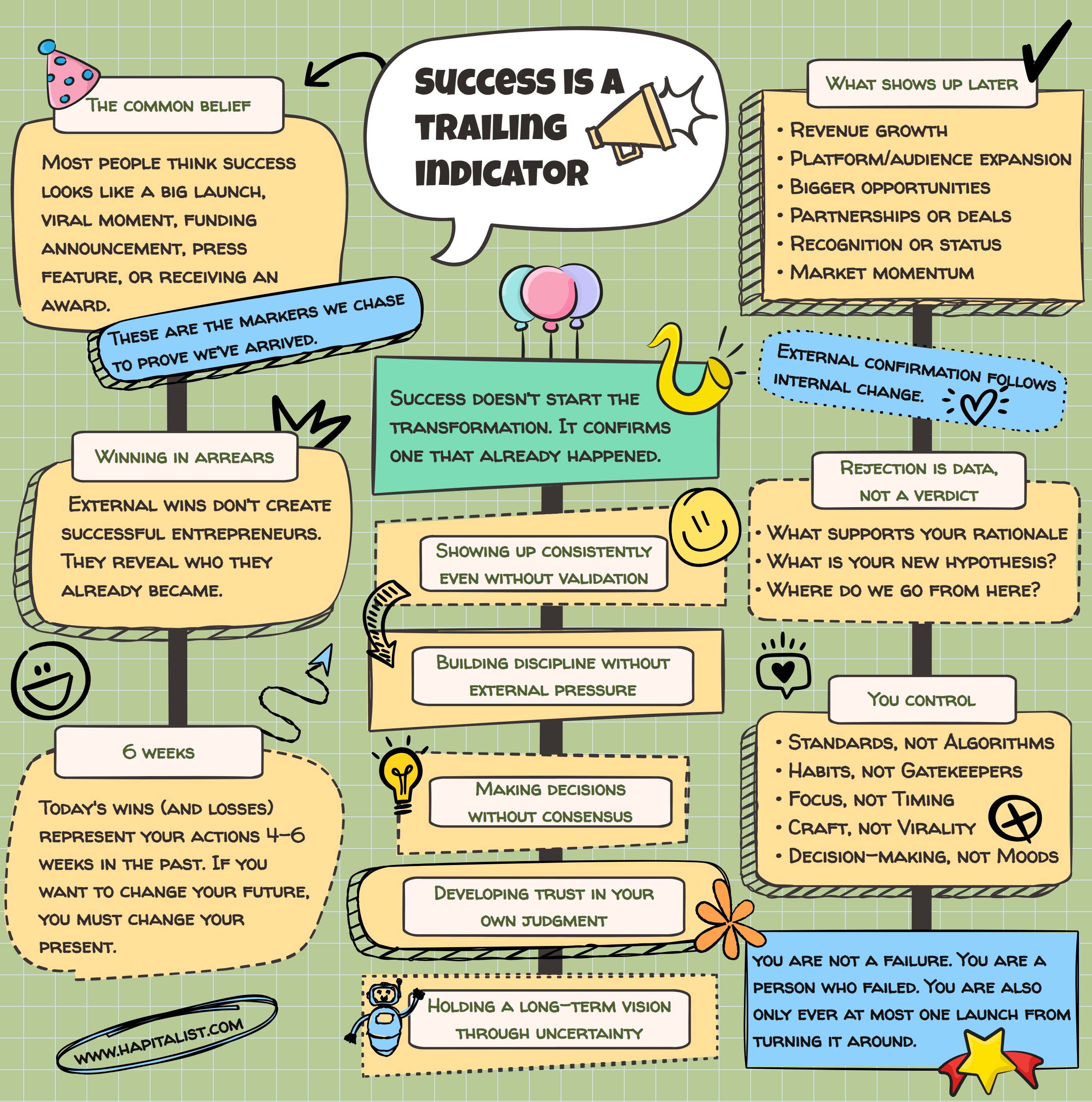
Success is a trailing indicator...
Most writers think success is proof they’ve made it, but what if it’s actually evidence of who they’ve already become?

This essay is part of a series I’m writing in conjunction with January Joy, a free slate of events I’m co-hosting with Claire Venus ✨ this month including live conversations with experts about how they grow with joy, challenges to help you plan your own joyous growth, and a masterclass at the end to wrap it all up. You can sign up for free to get access to all most of the events.
All you have to do is subscribe to the January Joy publication, and you’ll be registered for everything but the masterclass, which is $100. However, Hapitalist members get a free ticket. If you’ve been thinking about joining, this is a great time to consider an upgrade.
Hi,
Most writers believe success is a leading indicator that shows they’ve arrived.
Whether that’s the book deal, hitting the bestseller list, being offered the speaking invitation, or the profile in Publishers Weekly.
These are the markers we chase, the evidence we’ve crossed some invisible threshold into “made it” territory.
We watch for them like sailors scanning the horizon for land.
It’s really the inverse, though. What I’ve learned working with highly successful authors for over a decade is that success is actually a trailing indicator.
It’s not the beginning of something. It’s the evidence of something that already happened internally, often months or years before the external world caught up.
Heather Hildenbrand and I talk about this often, but it’s something that only really makes sense after you see it play out as many times as we have, with a diverse case of author success stories.
Think about the author who lands a six-figure deal. By the time that contract appears, something fundamental has already shifted.
They’ve already developed the discipline to show up at the page.
They’ve already pushed through dozens of failed drafts.
They’ve already cultivated the ability to hold a vision while everyone around them sees nothing.
The deal doesn’t create the writer, it reveals them.
What about the novelist whose third book finally breaks out? Their success isn’t what changed them. The change happened somewhere between books one and two, in the quiet months when they decided to keep going despite the silence, or maybe when they chose to write the book that scared them instead of the one that felt safe.
The bestseller list simply reported what was already true.
This pattern repeats itself across every success story I’ve witnessed.
The award-winning memoirist had already done the therapeutic work to face her trauma before the accolades arrived. The debut novelist who “came out of nowhere” had actually spent seven years learning story structure in the predawn hours before his day job. The writer who finally landed her dream agent had already stopped writing to the market and started writing toward her obsessions.
In every case, the external recognition was a lagging confirmation of an internal transformation that had already taken place.
Before the external markers arrive, something internal solidifies. A shift happens in how you see yourself and your work.
You stop waiting for permission and develop internal authority, the quiet certainty that what you’re doing matters, regardless of who’s paying attention.
This shift isn’t dramatic. There’s no lightning bolt moment. Most writers can’t even pinpoint when it happened. They just notice one day that they’re approaching their work differently.
They’re writing because the work demands to be written, not because they’re chasing validation.
They’re making decisions based on craft, not fear.
They’re in conversation with the work itself, not with their imagined critics.
This is the actual leading indicator. This is what precedes everything else.
I’ve seen this shift take different forms. For some writers, it arrives after a devastating rejection when they realize they can either quit or write anyway, and choose anyway. For others, it comes during a period of obscurity so long they finally stop performing and start exploring.
Sometimes it emerges from a workshop or a book or a conversation that reframes everything you thought you knew about your work, but however it arrives, the shift is unmistakable once it’s happened.
You stop asking “Is this good enough?” and start asking “Is this true?” You stop wondering if you’re a real writer and start doing the work that real writers do. You stop waiting for the industry to validate your existence and start validating your own choices.
This internal authority is the realization that you know what you’re doing and can trust yourself to get there.
When you understand that success is a trailing indicator, everything changes.
You stop waiting for external validation to prove you’re a real writer. You stop believing that the book deal or the award or the review will transform you into someone different.
You recognize that the transformation has to happen first, and that it’s entirely within your control, and start focusing on the things that actually create sustainable success: showing up consistently, developing your craft, building your capacity to handle uncertainty, learning to trust your own judgment.
These aren’t sexy, and won’t make good Instagram posts, but they’re what successful writers do in the years before anyone’s watching. Your current lack of recognition isn’t evidence of your lack of talent, but simply evidence that the trailing indicators haven’t caught up yet.
When a publisher passes on your manuscript, they’re not rejecting your potential. They’re making a business decision based on current market conditions, their existing list, their editorial capacity, and a dozen other factors that have nothing to do with whether you’re becoming the writer you need to become.
The rejection is data, not verdict.
It changes how you relate to other writers’ success, too. When a colleague lands the deal you wanted, you can recognize that their external success is trailing behind internal work you didn’t witness. Their trajectory says nothing about yours. Your leading indicators are just operating on their own timeline.
There’s something deeply freeing about recognizing that success trails behind internal change rather than leading to it.
It means you don’t have to wait. You don’t need anyone’s permission to become the writer you want to be. You don’t need the book deal to start acting like a professional. You don’t need the audience to start respecting your own time and work.
You can make this internal shift today.
You can decide that your writing matters. You can commit to the craft. You can build the habits that will sustain you through the long middle of a career.
And then, months or years from now, the trailing indicators will arrive. The opportunities will appear. The recognition will come, not because they created something new in you, but because they finally caught up with what you’d already become.
It means you can stop refreshing your email for agent responses and use that time to study a craft book. It means you can stop comparing your debut novel to someone else’s tenth and instead focus on what you’re learning from this project. It means you can stop trying to reverse-engineer the market and start building the body of work only you can create.
The writer who understands this distinction operates differently in the world.
They are less fragile because their identity isn’t hostage to external validation. They’re more consistent because they’re not waiting for motivation from outside sources. They’re more original because they’re listening to the work rather than to the marketplace’s echo chamber.
They’re also, paradoxically, more likely to achieve the traditional markers of success because the habits and mindsets that create internal authority are precisely the qualities that eventually produce publishable work.
Here’s what this looks like in practice:
Start treating your writing time as non-negotiable. Not because you have a contract, but because that’s what a professional writer does. Block the hours. Protect them. Show up even when no one would notice if you didn’t.
Invest in your craft development. Take the workshop. Buy the book on narrative structure. Study writers who do what you want to do. Successful writers don’t stop learning after they “make it.” They were serious students long before anyone was watching.
Build your capacity for uncertainty. Practice sitting with not-knowing. Get comfortable with the ambiguity of a draft that isn’t working yet. Develop your tolerance for the space between effort and outcome. This capacity is what allows writers to attempt ambitious work.
Trust your own judgment. Start making decisions based on what serves the work, not what you think will impress others. When you’re choosing between the safe chapter and the risky one, choose risk. When you’re deciding whether to pursue the concept that excites you or the one that seems more marketable, pursue excitement.
Create your own measures of progress. Instead of tracking agent responses or social media followers, track craft wins. Notice when you nail a character’s voice. Acknowledge when you solve a structural problem. Recognize when you write a sentence that surprises you. These are the leading indicators that matter.
The success will come. It’s a trailing indicator, remember? It will eventually catch up to the person you’re becoming.
But the becoming? That’s the only part you can control.,,
…and it’s also the only part that matters.
Stop chasing the markers. Stop waiting for external validation to tell you you’re ready.
The external validation will arrive or it won’t. But you’ll be a writer either way. You’ll have done the work that matters. You’ll have built something real.
And when the trailing indicators finally catch up you won’t need them to tell you who you are.
You’ll already know.
What do you think? If you want to start living in 2026, I’m co-hosting a free program this month with Claire Venus ✨ called January Joy.
It’s all about how to grow joyously in 2026, and also make the money you want to make. It’s filled with live conversations, challenges, and even a masterclass at the end of it.
The masterclass is $100, but the rest of it is completely free. Plus, it will be free for all Hapitalist members, and be available for watching afterward inside my archives.
Nice article! I’m my other life, in monitoring and evaluation, we’d call the six figure book deal (“success”) an impact indicator. It takes a long time to manifest, and is the culmination of both internal and external forces. It’s the internal ones you can control and influence. For new writers, it’s often the external ones (like social media influence) that is hard not to focus on. The more we focus on shifting and tracking progress on our internal forces over which we have control, the better for impact long term. Like, track how often you set aside time to write. How often do you celebrate your writing for yourself. How much time do you allocate to learning something new - how many c adjustments have you made to how you write?
Much better indicators than counting followers and subscribers.
But it’s so hard when we are on platforms not to get distracted and to compare our success with others apparent success.
Russell, this comment comes from reading your book, On Being Happy and a Successful Author at the Same Time. Specifically the chapter on Finding Your Brand.
You mentioning spotting the difference between Abercrombie &Fitch kids and Hot Topic kids at school.
I wasn’t a brand kid at all. For all of my elementary years my clothes were either hand made or hand me downs. I wonder if this lack of personal familiarity with brand identity will hinder me building a personal brand.
Even now in my life, in my 50’s, I am loath to buying branded merchandise.
Wondering what you think?